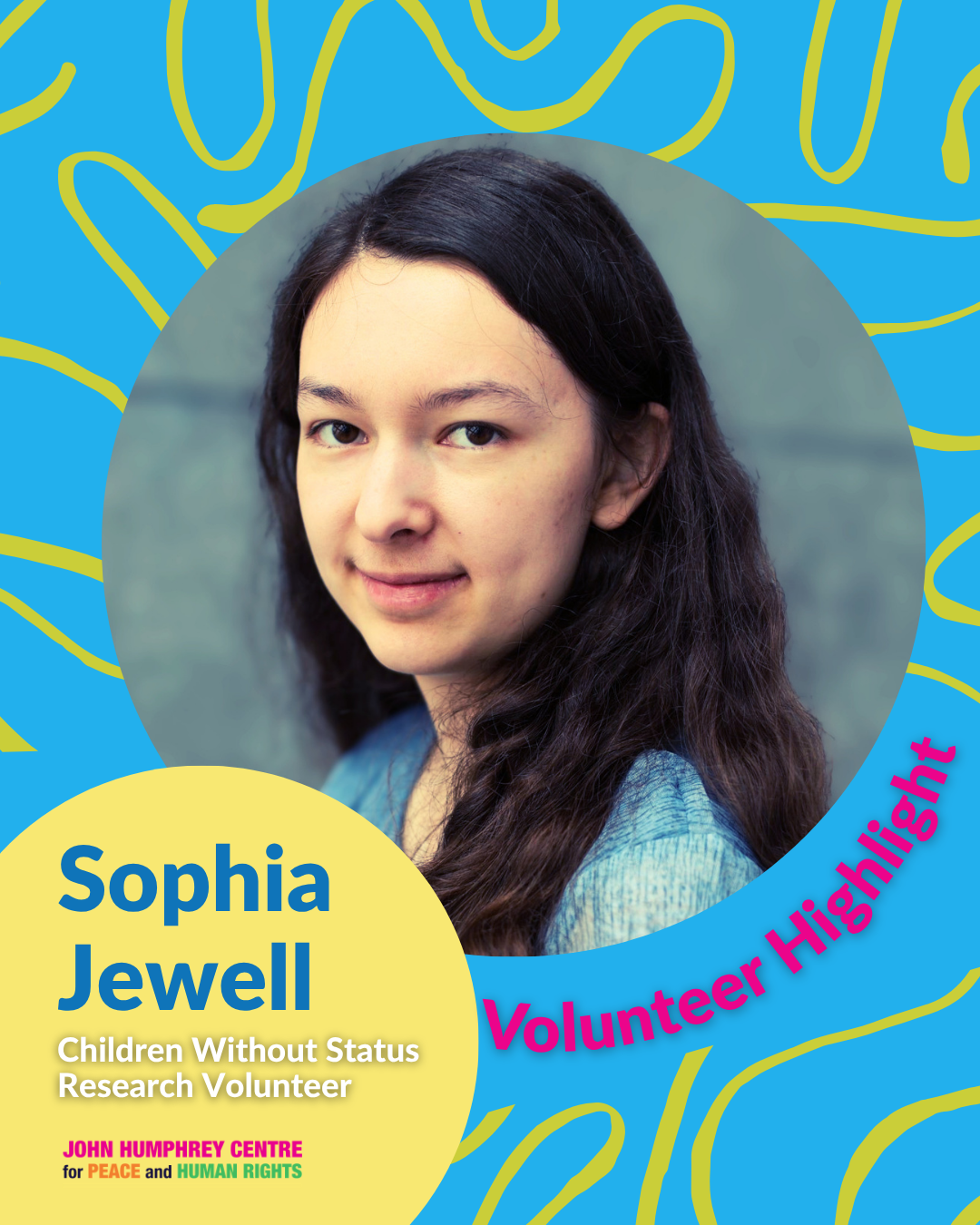
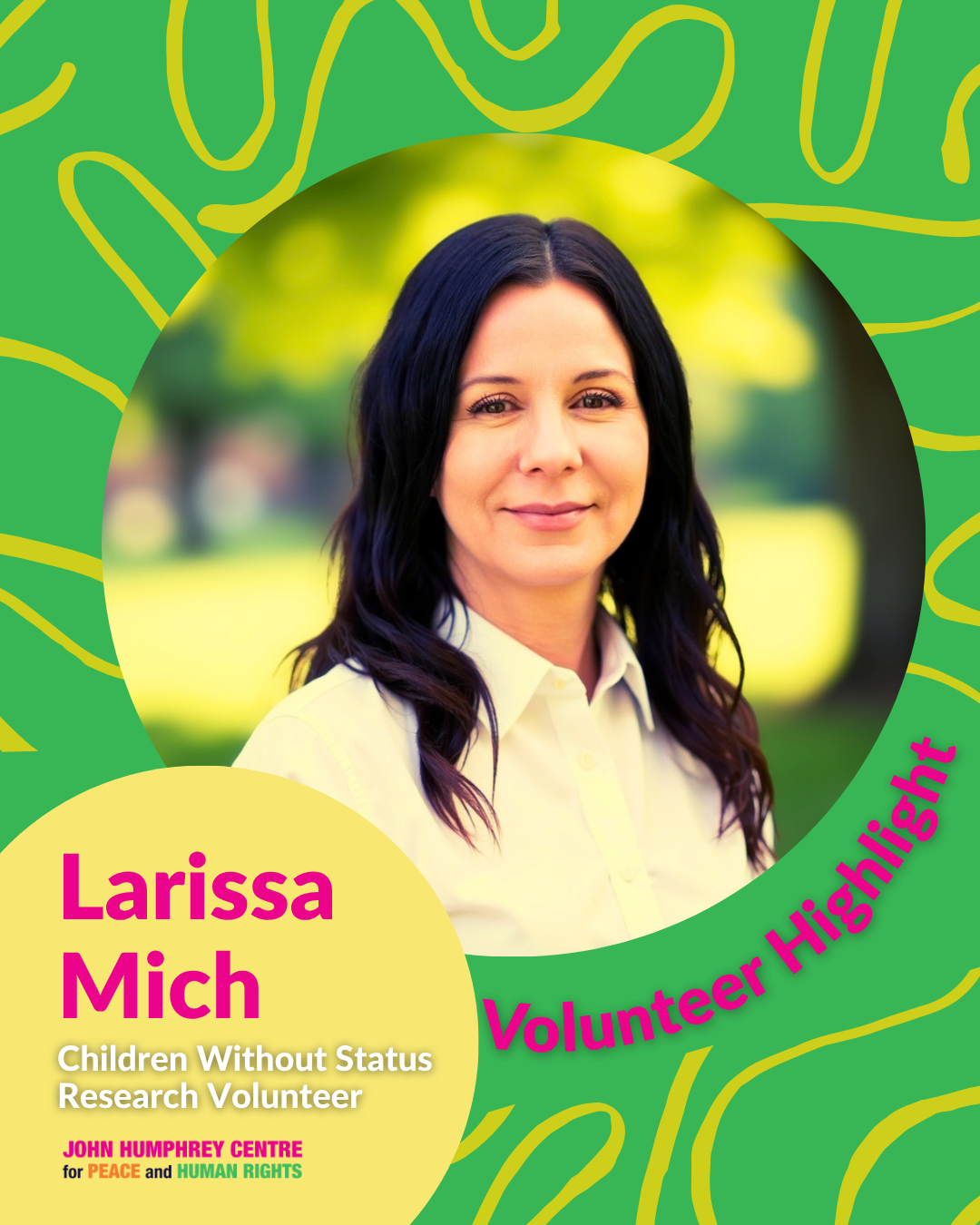
Volunteer Highlight: Sophia Jewell and Larissa Mich
For the past year, a team of volunteer advocates at the John Humphrey Centre for Peace and Human Rights (JHC) has been working on Upholding the Right to Education for Children Without Status in Canada, a research project focusing on children who are denied access to school due to their own or their parents’ immigration status. Grounded in international human rights law, the project aims to make access to education for children without status a national human rights priority.
Our volunteer team is working across three areas:
Economic and policy research. Sophia Jewell, volunteer advocate and researcher, prepared a recently published policy brief examining the costs of excluding children without status from public education and the benefits of ensuring access.
United Nations advocacy. Volunteers are finalizing a communication to the United Nations documenting barriers to education faced by children without status in Alberta and elsewhere in Canada. With families’ informed consent, the communication also shares their experiences, fully anonymized.
Public awareness. We are developing public education and advocacy initiatives, including social media, storytelling with families who choose to participate, and opportunities to bring together educators, families and human rights advocates.
We are grateful to these volunteers for the time and care they have brought to this work. In the blog post below, we share the learnings, experience, and reflections from two of the volunteers who have worked closely with JHC on this project: Sophia Jewell and Larissa Mich.
How and why did you first get involved with the John Humphrey Centre for Peace and Human Rights (JHC)?
Larissa: I first learned about the JHC through a colleague about two years ago. I was inspired to get involved because I believe in protecting human rights, particularly those of vulnerable populations such as children. I believe that every child, regardless of their circumstances or where they live in the world, deserves equal access to education. Education is not only a fundamental human right but also an essential foundation for creating more equitable, inclusive, and stable societies. Every child should have the opportunity to learn, grow, and reach their full potential without facing barriers beyond their control.
Sophia: The decision to involve myself directly in advocacy work has been incredibly enriching on both a community and personal level. I’ve always had a deep passion for human rights work. Getting involved in the work at the JHC offered me the opportunity to channel this desire into projects that contribute to social change. For me, this has allowed me to bridge my experience as a researcher with my desire to actively work in and with communities, allowing me to contribute in a way that directly impacts and supports local initiatives. It has also taught me so much about human rights advocacy as well as how to utilize advocacy tools across national and international contexts.
How long have you been a volunteer with JHC?
Larissa: Two years.
Sophia: I joined the John Humphrey Centre as a volunteer in early 2025. Back then, most of my contribution was focused on the Stride Advocacy program. When I first heard that the JHC was planning to prepare a submission to the UN on the rights of children without status and access to education, I expressed my interest in getting involved. The issue of migrant rights is one that is close to my heart, so I was very excited to play a role in this project.
Can you describe some of your volunteer activities?
Larissa: I have been helping with special events and collaborating with a team on a communication to the United Nations regarding access to education for undocumented children.
Sophia: The Education4All initiative has so many different aspects, all of which ultimately aim to support the submission of a human rights complaint to the United Nations regarding the right of children without status to education, as well as to increase awareness of this issue. My main focus has been on leading the development of a policy brief that highlights the public costs of excluding children without status from education in Alberta. This involved reaching out to experts and researchers across Canada for individual interviews and consultations. Speaking to experts in migration, political science, economics, sociology, education, criminology, and public health was a beneficial experience. It really showed me how the question of including children without status affects so many facets of our society for many generations to come. I combined these insights with a literature review of scientific research to produce the final report on how excluding children without status impacts not only children but also local communities in Alberta. Aside from this, I’ve also contributed to developing a media strategy to raise awareness about this issue among people in Alberta through public exhibits, social media posts, and podcasts, as well as supporting our human rights submission to the UN.
What has it been like to volunteer with this initiative and/or JHC as a whole?
Larissa: Volunteering with the JHC has been a rewarding and eye-opening experience. I’ve had the opportunity to meet and work with passionate people who genuinely care about protecting human rights and making a difference.
Sophia: Getting the opportunity to work as a researcher on this initiative has been incredibly enriching. The first thing is the strong sense of community support, from both our JHC team and volunteers working with other organizations. Whether working individually on research or collectively to organize events, there’s such a deep appreciation for the work and effort that everyone brings to this project. It’s an initiative where we’re always lifting each other up, and I think that matters immensely for both our outputs and the advocacy work that we do. Being able to work with adjacent organizations, by amplifying and supporting each others’ work, is also a key piece that allows us to work more effectively. In terms of the broader context, another aspect of this initiative is the overwhelming sense of urgency. Working on the issue of children’s right to education in the context of Alberta’s referendum has been a unique experience. At a time when Albertans are being asked to vote on whether newcomers should have access to basic social services, sharing factual information about the actual effects of these proposals becomes even more critical. In this context, this initiative held a lot of significance for me personally (as I think it did for many of us). It offered the chance to reiterate the right to education for all children in Canada and the impacts these policies have on local communities at a time when speaking out about these rights is so important.
What has surprised you the most about this role?
Larissa: I was surprised by how many organizations are working together to address this issue. Their collaboration and unity strengthen their collective efforts to resolve it.
Sophia: I’m continually amazed by what a small group of advocates can achieve when everyone is working together, with each person contributing in their own way. This project really is the result of a collective effort from people working across such a range of experiences, professional backgrounds, and unique skill-sets. I feel very lucky to get to work with so many cool people and to be a part of this effort.
Are there any learnings or challenges you have experienced through this work that you’d like to share?
Larissa: It can be challenging to dedicate the time this cause deserves, and it is disheartening to learn how many children face barriers to education.
Sophia: The main challenge I encountered was a technical one – the real lack of previous research on this topic in the Canadian context. While there has been significant research on the rights of children without status in the United States, research on the rights of children in Canada has been much more limited. When we look at the issue of education for children without status in Alberta specifically, it is difficult to find any research articles or policy documents. This really stood out to me given the fact that the question of access to education for children without status has become a key topic of debate in the public sphere and media here in Alberta. The lack of previous research creates a real gap. It’s both challenging but also motivating to do work that tries to fill that gap. It’s my hope that our work on this project can play some part in raising awareness about this issue and creating resources that can be used for further advocacy and research.
Where have you found inspiration or has kept you motivated to do this work?
Larissa: I am inspired by the families I have met whose children face barriers to education because of their undocumented status. Spending time with these wonderful people has allowed me to observe their resilience and determination to create change. This has left a lasting impression on me.
Sophia: As a young person born and raised in Canada, I grew up hearing stories about multiculturalism, inclusivity, and the differences that make us stronger. I also grew up hearing the stories of my ancestors who came from so many places and cultures: Poles who hid their language from their own children in order to fit in within Canada, Koreans who endured decades of war and occupation before coming to Canada, Acadians who narrowly escaped deportation during the great upheaval… Such stories aren’t just part of the past; they’re also part of who we are, and they leave a lasting impression on our communities. Last year, over 117.8 million people were displaced. Over 113,000 people applied for asylum in Canada to escape war or persecution, and 23,160 were uprooted and deported from their homes in Canada. The stories of each of these people are also part of our story. We cannot afford to treat some human rights as expendable. If we actually want a future that is multicultural, diverse, and welcoming, we need to actively work towards building institutions, communities, and spaces that support the rights of everyone. I think these things are worth fighting for, not just for ourselves, but also for future generations.
Anything else you'd like to share with us about your volunteer experience? Or insights you'd share with volunteers interested in supporting this type of work?
Larissa: Every effort counts, whether big or small. Even if you can’t commit a lot of time, do not let that stop you from getting involved with organizations like the JHC. Every contribution makes a difference.
Sophia: If I could have known ten years ago that one day I would get to be part of work like this, I know I would have been incredibly excited and really proud of where I ended up. Retrospectively, I realize that the opportunity to contribute to research on human rights and to advocate for local communities is something that is much more accessible than I would have imagined. I’d encourage anyone considering getting involved in this work to jump in and see what it’s like. Advocacy can take so many different forms, and I really believe that there’s something here for everyone.
What’s a message you’d like to send out to amplify this work you have been a part of? Or, if you could share one message to the world to amplify peace, justice, dignity, and human rights for all, what would your message be?
Larissa: Education is a fundamental human right, not a privilege, and children should not be denied that right because of circumstances beyond their control.
Sophia: As my mother often says, the world we live in is so deeply, deeply lonely. If I could give one message to the world, it would be the importance of understanding and really appreciating the relationality that reaches across our lives, connecting us to each other and to the world around us. We’ve been sold the lie that it is possible and even desirable to flourish by being independent and disconnected, and it’s cost us so much. It makes us forget about our embeddedness in the world and our entanglement with each other and just how amazingly beautiful those two things are. I think until we really try to understand how deeply we’re connected, we will never be able to understand the depth of the tragedy that is created by ignoring each others’ dignity or human rights.
Learn more about the Children Without Status initiative and read the recently published policy brief:
Children in Alberta and across Canada are currently being denied access to school because of barriers related to immigration status. The research over the past year has been examining the economic, social, health and legal impacts of exclusion and what Alberta stands to gain by ensuring every child can access education.
A recently published policy brief by Sophia Jewell, The Public Costs of Excluding Children Without Status from Education in Alberta, asks a simple question: What does excluding children without status from education actually cost Albertans?